What Is a Hinged Lid Box and What Is It Used For?

Time:2026-10-13 Author:Henry
0%

A Hinged Lid Box is a rigid package with a permanently attached lid. Its lid opens from one fixed edge, rather than separating from the base. This simple structure creates a controlled opening experience. It also protects products during handling, storage, and presentation.

Packaging author Walter Soroka defines packaging as “a coordinated system of preparing goods for transport, distribution, storage, retailing, and end use.” This principle explains why a Hinged Lid Box does more than look attractive. Its board grade, hinge strength, closure, and interior fit must work together. A poorly aligned lid may scrape the edge. A weak hinge can fail after repeated opening. Small details matter.

These boxes are commonly used for cosmetics, jewelry, electronics, tea, stationery, and premium gifts. A magnetic closure can produce a quiet snap. A molded insert can hold a glass bottle securely. Foam, paperboard, or fabric-lined interiors can prevent movement and surface damage. Many brands also use printed finishes, embossing, or textured paper to make the package memorable.

Still, appearance should not hide practical weaknesses. A heavy rigid box may increase shipping costs. Decorative coatings can complicate recycling. The best Hinged Lid Box balances protection, usability, branding, and material responsibility. It should feel refined, but not wasteful. It should open smoothly. More importantly, it should protect the product from factory to customer without unnecessary complexity.
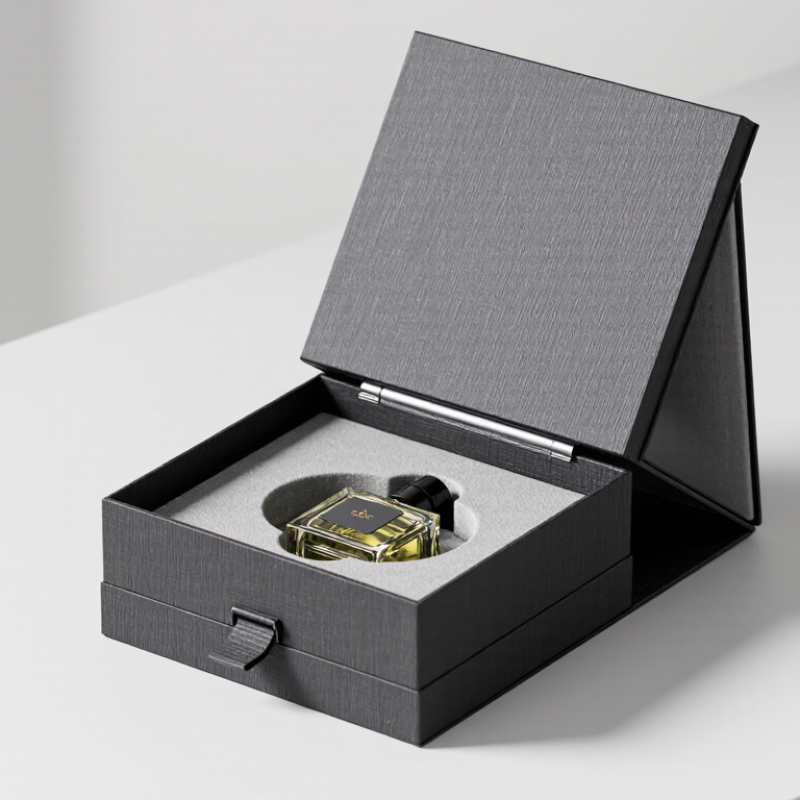
What Is a Hinged Lid Box and What Is It Used For?

Definition and Anatomy: Hinges, Panels, Closures, and Box Formats

A hinged lid box has a fixed base and a connected cover that opens along one edge. Its anatomy usually includes the lid, base panels, hinge, lining, and closure. The hinge may use fabric, paper, tape, or a concealed joint. Each choice changes opening resistance and durability. The lid must align.

Common formats include book-style boxes, shoulder-neck boxes, magnetic flap boxes, and folding carton versions. Rigid formats often use wrapped board over a paperboard or fiberboard core. The closure may use magnets, ribbon, tuck flaps, or friction fits. A practical inspection checks panel squareness, hinge tension, edge protection, and repeated opening. A beautiful box can still fail when its hinge drags.

Material decisions deserve more attention. The U.S. Environmental Protection Agency reported 82.2 million tons of packaging waste in 2018, with a 28.1% recycling rate. That figure supports reducing unnecessary layers and selecting separable materials. Smithers’ The Future of Packaging to 2028 forecasts the global packaging market above US$1.2 trillion by 2028, increasing pressure for efficient, durable formats. However, a lighter box is not automatically better. Weak panels may cause damage and replacement waste. Testing remains essential, though small packaging projects sometimes skip it. A hinged lid box is used for presentation, protection, organized storage, and controlled product access.

Opening Geometry: 90°–180° Hinges, Magnetic Closures, and Fit Tolerances

A hinged lid box is a rigid container with a connected cover that swings from a fixed edge.

It protects products while creating a more deliberate opening experience. Common uses include gift packaging, presentation kits, keepsake storage, and premium product sets. In practical packaging work, the hinge angle matters as much as the outer appearance. A 90° hinge keeps the lid upright and saves space. A 180° hinge folds the lid flat, which helps during display or filling.

Opening geometry also affects access and perceived quality.

A lid that stops too early can hide the contents. One that opens too far may strain the hinge or scrape the outer surface. Magnetic closures offer a clean, quiet release, but their strength must match the box size. Weak magnets allow movement during handling. Excessive magnetic force can make opening feel awkward. Small details matter here. Even the sound of closure can influence user confidence.

Fit tolerances require careful testing because board thickness, fabric wrapping, and humidity can change the final gap.

A small clearance prevents the lid from rubbing against the base. Too much clearance creates visible misalignment and weakens the premium feel. As a practical rule, test samples through repeated opening cycles, not just one inspection. A perfect fit is not always ideal. Real materials move. That part is easy to underestimate.

Material Data: 1.5–3.0 mm Board, GSM, Coatings, and FSC Fiber

A hinged lid box uses a fixed paperboard hinge to open like a small book. It protects jewelry, cosmetics, gifts, and premium printed items. The lid also creates a clear unboxing moment. Its performance depends heavily on board construction, not decoration alone.

For rigid hinged boxes, 1.5–3.0 mm board usually provides useful compression strength. Basis weight varies by fiber type and density, so thickness cannot be converted into GSM precisely. Many specifications fall near 900–2,000 GSM. ISO 536 defines GSM as mass per square metre, making it essential for comparing samples accurately. The Smithers report Future of Folding Cartons to 2028 notes continued demand for lightweight structures with stronger presentation value. That balance is difficult. More board can improve stiffness, but it also increases material use and shipping weight.

Coatings change the practical result. Water-based coatings can improve scuff resistance, while plastic films may complicate fibre recovery. CEPI’s European Paper Recycling 2023 statistics reported a paper recycling rate of about 80% in Europe, but coated packaging still requires suitable mill processes. FSC Facts & Figures 2023 reported more than 160 million hectares under certification, supporting traceable fibre sourcing. A credible specification should state GSM, thickness, coating type, recycled content, and certification status. Small gaps matter. In one prototype, the board felt rigid but cracked near the hinge after repeated opening. The specification looked correct; the folding test was not.

Manufacturing Workflow: Die-Cutting, Scoring, Wrapping, Gluing, and QC

A hinged lid box is a rigid package with a lid attached along one edge. It opens like a small book and protects products between uses. Common applications include cosmetics, gifts, electronics accessories, specialty foods, and presentation kits. Its value comes from structure, not decoration alone. A reliable box should open smoothly, close squarely, and resist corner collapse during handling.

Manufacturing starts with board selection based on product weight and required stiffness. Die-cutting creates the box panels, lid, tabs, and corner sections. Scoring forms clean folding lines without cracking the surface. Even a small scoring error can make the lid sit unevenly. After cutting, operators wrap printed paper around the rigid board. Edges are folded tightly, especially around corners. Glue is then applied to secure the wrap and assemble the shell. Too much adhesive can cause ripples; too little may create lifting edges. Quality control checks dimensions, hinge movement, surface bubbles, glue marks, and lid alignment. A sample can look excellent, yet fail after repeated opening. That weakness deserves another inspection.

Tips: Test the box with the real product inside. Check clearance around the hinge. Review corners under bright light. Keep a small tolerance for material variation, because production is rarely perfectly uniform.

Testing and Sustainability: ISTA 3A, ASTM D4169, and ISO 18606 Criteria

A hinged lid box combines a rigid base with an attached cover. The lid opens repeatedly without a separate piece. This structure suits gifts, electronics, cosmetics, documents, and reusable storage. Its clean opening experience is attractive, but the hinge remains a vulnerable point during transport.

Testing should reflect the real distribution route. ISTA 3A examines packaged products through hazards such as handling drops, vibration, compression, and environmental conditioning. It is a performance test, not a permanent quality certificate. ASTM D4169 offers distribution cycles that help evaluate shipping risks under defined severity levels. Test samples should match production materials, dimensions, closures, and internal protection. Otherwise, the result may look convincing but prove little.

Sustainability requires a different question. ISO 18606 addresses packaging designed for organic recycling, including composting and biodegradation conditions. A hinged lid box may need suitable fiber materials, limited problematic coatings, and components that support processing. Strong adhesives or mixed materials can complicate recovery. That trade-off deserves measurement, not optimistic wording. A box can survive transit and still perform poorly in recycling systems. It can also use less material yet fail after one rough delivery. Testing teams should document damage, product protection, material composition, and end-of-life assumptions. Real-world feedback matters. Lab conditions are necessary, but never perfect.

What Is a Hinged Lid Box and What Is It Used For? - Testing and Sustainability: ISTA 3A, ASTM D4169, and ISO 18606 Criteria
Dimension Data or Criterion Why It Matters Typical Evaluation Method Practical Result
Definition A hinged lid box is a rigid or semi-rigid container with a lid permanently connected to the base by a hinge, fold line, fabric strip, or molded joint. The attached lid allows repeated opening and closing while keeping the lid and base together. Inspect the construction, hinge attachment, closure, and alignment during manual use and laboratory testing. Reusable access
Common Materials Typical materials include corrugated fiberboard, paperboard, molded fiber, wood, plastics, and combinations of these materials. Material selection influences stiffness, moisture resistance, impact performance, recyclability, and end-of-life options. Record material composition, coatings, adhesives, fasteners, inserts, and surface treatments. Performance depends on construction
Typical Uses Used for product presentation, protective storage, subscription shipments, gift packaging, sample kits, documents, retail packs, and reusable transport containers. The hinged format combines protection with convenient access and can reduce the need for a separate removable lid. Assess opening frequency, product fit, handling conditions, closure security, and expected reuse cycles. Suitable for repeated access
Product Protection Protection is provided by the box walls, lid, corner structure, internal inserts, cushioning, and closure system. A well-fitted package limits movement and helps protect contents from compression, impact, abrasion, dust, and ordinary handling hazards. Evaluate dimensions, clearance, insert retention, closure strength, and visible product damage after distribution simulation. Design-specific
Closure Performance Common closures include tuck flaps, tabs, magnetic components, hook-and-loop fasteners, snap features, straps, and locking folds. The closure must remain secure during handling without preventing the intended user from opening the package. Perform repeated opening-and-closing cycles followed by vibration, shock, compression, and visual inspection. Verify through testing
Hinge Durability The hinge is a potential wear point because it experiences bending, tension, shear, and repeated movement. Hinge failure can cause lid separation, poor alignment, loss of closure function, or reduced package protection. Use a defined cycle test, such as repeated opening and closing under the intended operating conditions, followed by functional inspection. Set a use-life target
ISTA 3A Scope ISTA 3A is a general simulation test for packaged-products shipped through a parcel delivery system. It applies to individual packages up to 70 kg, including standard, small, flat, and elongated packages. It helps evaluate whether the packaged product can withstand hazards associated with parcel distribution. Use the applicable ISTA 3A procedure, including the specified conditioning, shock, vibration, and other required distribution simulations. Procedure-specific
ISTA 3A Acceptance Typical acceptance criteria include no product damage, no loss of intended function, and no package damage that could create a safety or usability problem. Passing requires predefined acceptance criteria rather than simply keeping the box visually attractive. Define pass/fail requirements before testing and document package condition, product function, and test results. Define criteria in advance
ASTM D4169 Scope ASTM D4169 provides a framework for evaluating shipping units under laboratory simulations of hazards that may occur during handling, transportation, and storage. It can be applied to many distribution environments and packaging configurations. Select the appropriate distribution cycle, assurance level, test sequence, and shipping-unit orientation for the intended distribution system. Configuration-specific
ASTM D4169 Test Factors Relevant factors may include atmospheric conditioning, vehicle or air vibration, manual or machine handling, concentrated impacts, warehouse stacking, and compression. These factors represent different risks that can affect the box, hinge, closure, inserts, and packaged product. Choose only the distribution hazards that match the real supply chain; the selected cycle controls the test sequence. Match the supply chain
Compression and Stacking Compression testing evaluates the ability of the shipping unit to withstand loads that may occur during stacking and storage. Weak lid panels, corners, or sidewalls can buckle and transfer damaging loads to the contents. Test the assembled package in the intended orientation, considering load distribution, stacking duration, humidity, and package condition. Important for stacked loads
Shock and Impact Shock hazards can occur when packages are dropped, tipped, struck, or handled roughly during distribution. Impact testing reveals failures such as cracked panels, detached hinges, opened closures, damaged inserts, or product breakage. Inspect the package and product after the prescribed shock or impact sequence and compare results with the defined acceptance criteria. Inspect function and damage
Vibration Transport vibration can cause repeated rubbing, loosening, fatigue, product movement, and progressive hinge or closure damage. A box that survives a single impact may still fail after prolonged repetitive motion. Use the vibration method required by the selected ISTA 3A or ASTM D4169 test plan, with the correct package orientation and restraint conditions. Evaluate fatigue risk
ISO 18606 Focus ISO 18606 addresses packaging and the environment, with requirements and guidance for packaging suitable for organic recycling, including biological treatment processes. It is relevant when a hinged lid box is intended to be managed through an organic recycling route rather than conventional material recycling or disposal. Review the packaging design, material composition, disintegration behavior, biodegradation characteristics, and suitability for the intended organic recycling system. End-of-life route matters
Organic-Recycling Design Paper, board, and molded-fiber structures may be candidates for organic recycling, but coatings, laminates, inks, adhesives, plastic components, and metal parts must be assessed as part of the complete packaging. A fiber-based appearance alone does not prove that the entire box is suitable for organic recycling. Assess the complete packaging system and use the requirements of the intended collection, treatment, and certification framework. Assess the complete system
Material Separation Mixed-material features such as magnets, plastic windows, metal hinges, foam inserts, and laminated surfaces can complicate recycling or organic treatment. Separating components can improve sorting and help prevent contamination of recycling streams. Document each component and determine whether it can be removed by the consumer, separated during processing, or accepted by the intended facility. Design for separation
Reuse Potential A durable hinged lid box can support multiple opening, closing, storage, or transport cycles before disposal. Reuse can reduce packaging demand per use when the box is strong enough and the reuse system is practical. Measure functional performance after a defined number of reuse cycles, including hinge movement, closure retention, dimensional stability, and cleanliness. Potentially lower use-phase impact
Sustainability Metrics Useful metrics include material mass, recycled content, renewable-fiber content, package-to-product ratio, number of reuse cycles, empty volume, and end-of-life recovery route. These metrics provide a more complete view than judging sustainability by material appearance alone. Record measured values and compare alternatives using the same product protection, distribution, and end-of-life assumptions. Use measurable indicators
Recommended Test Plan Confirm dimensions and mass; inspect materials; test closure and hinge cycles; condition samples; run the applicable ISTA 3A or ASTM D4169 sequence; then assess end-of-life suitability. A combined plan addresses both distribution performance and environmental claims. Prepare a written protocol with sample quantity, package orientation, conditioning, sequence, measurements, acceptance criteria, photographs, and final disposition. Documented verification

Note: ISTA 3A, ASTM D4169, and ISO 18606 are applied according to the specific packaging design, product, distribution system, material composition, and intended end-of-life route. Test conditions and acceptance criteria should be selected from the applicable edition and project requirements.

FAQS

What is a hinged lid box?

It has a fixed base and a connected cover opening along one edge. The hinge acts like a small book spine.

What parts make up this box?

Common parts include the lid, base panels, hinge, lining, and closure. The panels should meet cleanly.

Which closure options are available?

Common choices include magnets, ribbons, tuck flaps, and friction fits. Each creates a different opening feel.

What board thickness is commonly used?

Rigid boxes often use 1.5–3.0 mm board. Many samples fall near 900–2,000 GSM.

Does greater thickness always improve performance?

No. Thicker board can increase stiffness, material use, and shipping weight. Weak hinge construction can still cause failure.

What should be checked during inspection?

Check panel squareness, hinge tension, edge protection, and repeated opening. The lid must align.

How can coatings affect recyclability?

Water-based coatings may improve scuff resistance. Plastic films can make fibre recovery more difficult.

What information belongs in a material specification?

State GSM, thickness, coating type, recycled content, and certification status. Small gaps can create large problems.

Why is repeated opening testing important?

A rigid box may still crack near the hinge. One prototype looked strong but failed after repeated folding.

How can packaging become more efficient?

Reduce unnecessary layers and choose separable materials. A lighter box is not automatically better. Test it first.

Conclusion

A Hinged Lid Box is a rigid or semi-rigid package made with a connected base and lid that open along a scored or attached hinge. Its main components include the lid, side panels, base, closure, and interior fit structure. Depending on the design, the lid may open from approximately 90° to 180°, while magnetic closures or other fastening methods help maintain alignment. Careful fit tolerances are essential to ensure smooth opening, secure closing, and consistent presentation.

Typical production uses 1.5–3.0 mm board, with GSM selected according to strength and appearance requirements. Coatings can improve surface protection, while responsibly sourced FSC fiber supports sustainable material choices. Manufacturing generally involves die-cutting, scoring, wrapping, gluing, and quality control inspections. Performance may be evaluated through ISTA 3A and ASTM D4169 distribution testing, while ISO 18606 criteria can guide recyclable or compostable packaging considerations. Together, these structural, material, manufacturing, and testing factors determine the box’s durability, usability, and environmental profile.


Henry

Henry

Henry is a dedicated marketing professional with a profound expertise in the company's offerings. With years of experience in the industry, he possesses an impressive understanding of the market dynamics and consumer behaviors that drive success. Henry is committed to sharing his insights through......